Capsella Flower (A Dicot)
 Capsella Flower (A Dicot)
Capsella, a member of the Mustard Family (Brassicaceae) is used as an example of Dicot Embryogenesis.
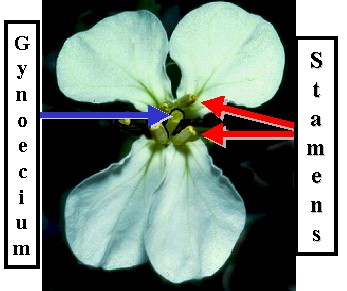
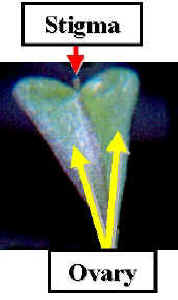
The flower has four Sepals and four Petals, plus six Stamens. The syncarpous gynoecium is composed of two carpels.
|
|
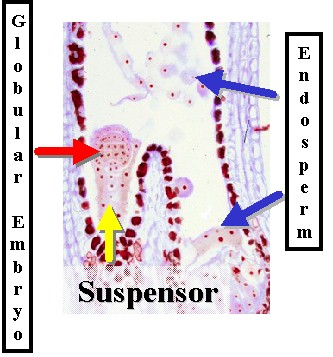
Embryo Development occurs within the Ovule, near the Micropyle. The zygote has a transverse division which produces a Terminal and a Basal cell. The Basal Cell divides transversely to produce the Suspensor. The Terminal Cell divides in many planes to produce a 3-Dimensional structure called the "Embryo Proper". The Embryo Proper produces most of the embryo. The Suspensor contributes to the formation of the Root Apex. Further growth of the Embryo Proper leads to a Globular stage. |
Ovule with Globular Embryo
|
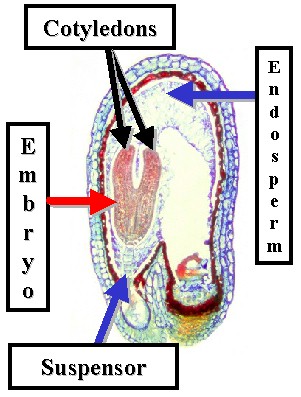
| Two cotyledons develop near the shoot apex and make the embryo resemble a heart. Thus, the name, "Heart Stage" is applied to the embryo at this point. |
|
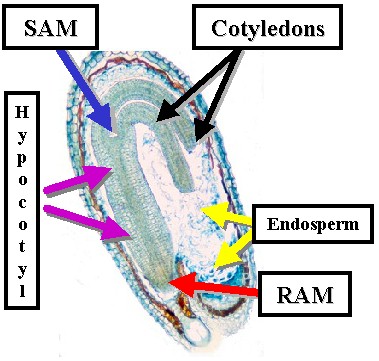
| The cotyledons become large structures in Capsella and familiar legumes like peas and beans. In some cases the cotyledons do not occupy the greatest part of the seed which may contain a large, residual endosperm. |
SAM = Shoot Apical Meristem RAM = Root Apical Meristem |