WB01343_.gif (599 bytes)

Psilophyta-4

WB01339_.gif (896 bytes)

The Aerial Stem is Grooved & Stomata Occupy Grooves & are Sunken, as well. Do these traits have adaptive significance?

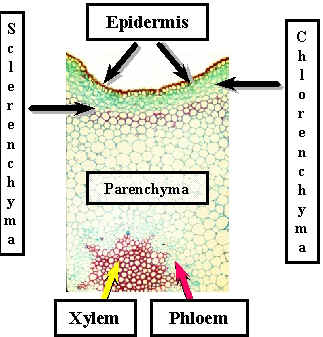
The outer Cortex has Photosynthetic Parenchyma (Chlorenchyma). Air Spaces are associated with the Chlorenchyma. I wonder why?

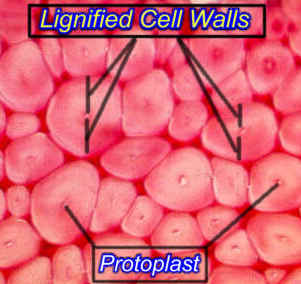
The Cortex also contains a tissue called Sclerenchyma. Cells of this tissue are usually elongated and have thick organized & lignified  cell walls. This makes them very rigid & strong, thus providing structural support.

The inner Cortex contains Parenchyma cells that store starch & an Endodermis.

Stele
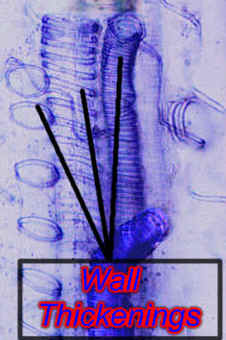
The aerial stem usually has an Actinostele. The Xylem is composed of Tracheids. These have elaborate Secondary Cell Wall thickenings, unlike the Hydroids of Bryophyta. There are numerous Pits present in the cell walls. Pits are more numerous on the end walls where the Tracheids overlap. This facilitates Longitudinal Transport. Furthermore the walls are Lignified & this provides Structural Support
.

Tracheids represent one of the most fundamentally important adaptations for terrestrial plants because of their two major functions, but especially because of their superior ability to facilitate long distance transport of water. They are the only type of Tracheary Element present in most land plants. Flowering Plants contain Vessel Members which are more specialized and varied in their structure. Tracheary Elements are Dead at maturity!

Vascular Plants were once grouped into sub-phyla under the Phylum Tracheophyta, because of the relative importance that Botanists attached to the presence of Tracheary Elements & Sieve Elements in Plant Evolution.

The thick highly organized cell walls of Tracheary Elements & Sclerenchyma make them appear bright with Polarized Light!

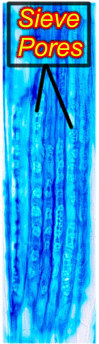
The Phloem contains Sieve Cells. SieveCellsLab100.jpg (23751 bytes)These superficially resemble Tracheids. However they have many fundamental differences.

They are alive at maturity & their walls are not lignified. They have large pits called Sieve Pores. These enhance transport.

Sieve Cells usually contain the polysaccharide Callose.

The lack of Callose in Psilotum could mean that it has lost the ability to synthesize Callose or that it never had this adaptation. The latter could mean that the Psilophyta are not on the main evolutionary chain leading to flowering plants.


The Epidermis has a cuticle but is hairless.
StemX-S.jpg (38239 bytes)
Psilotum Stem Cross-section

StemX-SMediumMag240Lab.jpg (86075 bytes)
Psilotum Aerial Stem Cross Section

StemX-SPol240.jpg (59778 bytes)
Psilotum Stem Cross Section with Polarized Light
StelePol240.jpg (36704 bytes)
Stele seen with Polarized Light
Where is the Xylem? Where is the Phloem?

ProtoxylemSpirals200Lab.jpg (37173 bytes)
Secondary Cell Wall thickenings in Xylem. These increase the strength of Tracheids.

Tracheid1-150.gif (5075 bytes)
A typical Tracheid - Note the overall shape. These provide structural support when they are found in groups.

TrachEndLab300.jpg (14155 bytes)
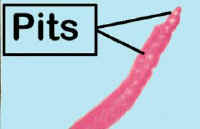
Tracheid End Wall (Tip) - There are many Pits at the tips. Pits are also present on the Side Walls.

Sclerenchyma Fibers have a similar shape but lack Pits. They are specialized for support!

FiberOakWood-300.jpg (11484 bytes)
Fiber isolated from Oak Wood

FibFraxCropLab.jpg (34791 bytes)
Fibers with extremly thick Cell Walls. The living contents of the Cells (Protoplast) are confined to a narrow space at the center of the Fibers.

Note the Thick Walls of the Sclerenchyma Fibers in the Photo below. The red color indicates the presence of Lignin.
FibersWalLayersCrop.jpg (30270 bytes)

WB01337_.gif (904 bytes)

Lecture Directory