|
Rhyniophyta |
 |
These plants do not seem very important. They are small, lack diversity and have little ecological significance.
However, they closely resemble the oldest fossil land plants (Rhyniophyta) that have been discovered. Consequently, they give us some ideas about the adaptations which occurred in the first land plants.
Remember the concept that the Invasion of the Land is the Invasion of the Air.
Another concept to remember is that Evolution has led to the internalization of structures.
Evolution has also lead to the grouping or fusion of Sporangia.
Models of Ancestral Vascular Plants |
|
| The oldest
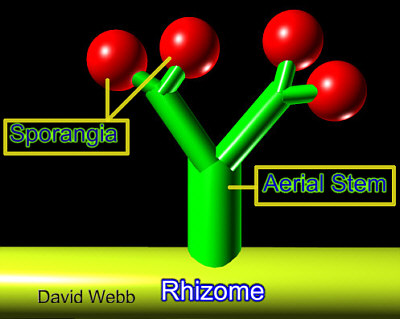
fossil plant had a dichotomously branched system of stems. There was a horizontal Rhizome which gave rise to Photosynthetic Aerial Stems. A single sporangium occurred at the apex of the
aerial shoots. There were no Leaves nor Roots. The Rhizome probably produced Rhizoids. The next step in Evolution probably involved Anisotomous branching such that a short & long branch occurred at each dichotomy. This produced pseudomonopodial growth in which there appeared to be one main axis for each major branch. The individual Sporangia were borne at the tips of short branches and occurred in tight clusters. The next step could have been the fusion of individual Sporangia to form a Synangium like that found in Psilotum. These plants had a Protostele like the Rhizome of Psilotum. |
The genus Cooksonia is thought to
contain the most ancestral land plant. Model of the oldest know terrestrial plant.
|