 BOT 201 Lycophyta -
Lycopodium Lab
BOT 201 Lycophyta -
Lycopodium Lab  BOT 201 Lycophyta -
Lycopodium Lab
BOT 201 Lycophyta -
Lycopodium Lab 
The Lycophyta constitutes a relatively large group of organisms compared to the Psilophytina and Sphenophytina. However, there are only 6-12 genera and approximately 1000 species. Tree-like lycopods existed during the course of evolution but extant species are small and herbaceous. They are either terrestrial or epiphytic and some species can exhibit both growth forms. Lycopods are most abundant in the tropics, however, some small robust species can be found in temperate forests and even the arctic-alpine zone. They do not usually form dominant components of major ecosystems but may be locally abundant. Lycopodium cernuum (wawae iole - rat's foot) appears to play a role in soil stabilization becuase it grows into disturbed areas where little else grows.
Species of Lycopodium
and Selaginella have Microphylls.
Microphylls are leaves with only one vascular bundle that is
connected to the stele of the stem. They may be Isophyllous
(same leaf) or Anisophyllous (not the same leaf). Leaves
associated with sporangia (Sporophylls)  can differ from vegetative leaves. Sporophylls may be grouped into Strobili
(cones) or distributed in sectors along the main stem. Branching
is Dichotomous. This can be Isotomous
(equal branches) or Anisotomous. Anisotomus
branching occurs when there is unequal elongation
of stems following dichotomous branching. This can result in stems which appear to have
one central axis (Monopodial). However, true monopodial
branching is a due to lateral branching. Consequently, the term Pseudomonopodial
is applied to Anisotomous. branching which resembles monopodial branching.
can differ from vegetative leaves. Sporophylls may be grouped into Strobili
(cones) or distributed in sectors along the main stem. Branching
is Dichotomous. This can be Isotomous
(equal branches) or Anisotomous. Anisotomus
branching occurs when there is unequal elongation
of stems following dichotomous branching. This can result in stems which appear to have
one central axis (Monopodial). However, true monopodial
branching is a due to lateral branching. Consequently, the term Pseudomonopodial
is applied to Anisotomous. branching which resembles monopodial branching.
Most species have an underground Rhizome which produces aerial branches and roots. A few species have Stolons which are horizontal aerial stems. These produce upright stems and roots. Roots branch dichotomously.
Lycopodium
is Homosporous but Selaginella
is Heterosporous. We will study Lycopodium in
this lab and return to study Selaginella later. Heterosporous
forms produce Microspores and Megaspores.
 These
are housed in Microsporangia and Megasporangia.
These are produced by microsporophylls and megasporophylls.
Heterosporous taxa usually have their sporophylls assembled
into cones.
These
are housed in Microsporangia and Megasporangia.
These are produced by microsporophylls and megasporophylls.
Heterosporous taxa usually have their sporophylls assembled
into cones.

We will concentrate on the most complex species (Lycopodium cernuum (wawae iole - rat's foot) which is found in Hawaii.
This species has a Stolon, Aerial Branches and Adventitious Roots.
External Morphology
What is an Adventitious root?
What is a Stolon?
What type(s) of branching is displayed by this plant?
Can the term Pseudomonopopdial be applied to this species?
Locate the Sporophylls. What is noteworthy about these?
Is this plant Isophyllous or Anisophyllous?
Internal Anatomy
Examine fresh sections of stems, roots and leaves prepared by your dauntless lab instructors (That must include me!!!).
Stain with Phloroglucinol
& Toluidine Blue.
Note the general organization of tissues in various stems. It might be useful to make outline drawings of these.
Is an Endodermis present?
What type(s) of Stele
do you see?
Can you locate Leaf Traces in the cortex?
How does the Root anatomy resemble that of the shoot(s).
Compare Sporophylls
with Vegetative Leaves from an external and internal
perspective. 
Is there evidence of structural and functional specialization?
Observe cross sections of Vegetative Leaves and Sporophylls.
Note Key features of the various tissues.
Is there evidence of Tissue Specialization?
What are the advantages of Cones? I can think of one that involves climate.
Can you think of others?
Tease open some Sporangia and examine spores with your compound microscopes.
What is the color of the spores?
Observe Demo of spores Stained with Sudan.
What type of storage product is present in the spores?
|
|
 |
Long section of Lycopodium Cone |
Long section of Lycopodium Sporangium |
Tetrads of Lycopodium Spores |
Observe slides of Vegetative and Reproductive structures & compare these to the plant materials that we examined above.

Selaginella is usually bilaterally flattened and has small dorsal leaves and large ventral leaves. Some species are erect, however. They always have Cones and are Heterosporous. They branch dichotomously and are usually Anisotomous.
Roots originate from the stems and are usually found at branch points. Roots also branch dichotomously.
We will study a species (Selaginella
arbuscula) which  grows along the Manoa Cliffs trail.
It is usually found in dark wet areas and is not extremely abundant so don't pick
specimens unless you really need one.
grows along the Manoa Cliffs trail.
It is usually found in dark wet areas and is not extremely abundant so don't pick
specimens unless you really need one.
External Morphology
What type(s) of branching
is displayed by this plant?
Can the term Pseudomonopopdial be applied to this species?
Locate the Sporophylls. What is noteworthy about these?
Is this plant Isophyllous
or Anisophyllous?
Locate an Adventitious root?
Internal Anatomy
Examine fresh sections of stems, roots and leaves prepared by your peerless lab instructors (That must include me!!!).
Stain with Phloroglucinol & Toluidine Blue.
Note the general organization
of tissues  in various stems. It might be useful to make
outline drawings of these.
in various stems. It might be useful to make
outline drawings of these.
Is an Endodermis present? What is unusual about it?
What type(s) of Stele do you see?
Can you locate Leaf
Traces in the cortex?
How does the Root anatomy resemble that of the shoot(s).
Compare Sporophylls with Vegetative Leaves from an external and internal perspective.
Is there evidence of structural
and functional specialization?
Observe cross sections of Vegetative Leaves and Sporophylls.
Note Key features of the various tissues.
Is there evidence of Tissue Specialization?
What are the advantages of Cones?
I can think of one that involves climate.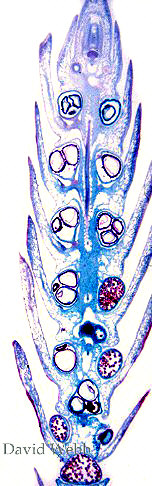
Can you think of others?
Tease open some Sporangia and examine spores with your dissecting microscopes.
Do you detect two spore types? Yes I do? Describe the differences you observe.
Examine the spores at low power with your compound microscopes.
These plants are Heterosporous.
What are the benefits of heterospory?
Observe slides of Vegetative and Reproductive structures & compare these to the plant materials that we examined above.
Examine Slides which contain cross-sections of Stems, Leaves & Roots
Examine a Demos of a cleared whole Cone (Strobilus).
Locate the Megasporangia & Microsporangia
Follow the development of Megaspores by scanning sporangia from the top to the bottom of the Cone


