The remainder of the Ascomycota are the mycelial Ascomycota. These species have septate, mycelium and produce asci and ascospores that are borne in an ascocarp. There are four types of ascocarps recognized; cleistothecium, perithecium, apothecium and ascostroma. The latter is a acavity that has been produced in a stroma to accomodate the asci and ascospores.
The development of the various types of ascocarp is very variable, but certain events are consistently present in most types of ascocarps. We will use Pyronema domesticum, an apothecium forming species as an example of ascocarp development:
Asexual reproduction, when present, occurs by
conidia. Asexual spores borne in sporangia do not occur in this division. The
mycelial Ascomycota can also be divided into two ascus types. Species that produce
cleistothecia, perithecia and apothecia have unitunicate asci while . those that
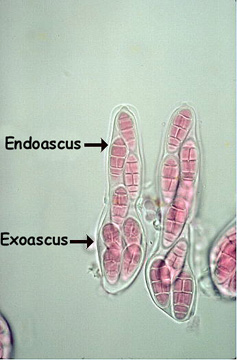
produce ascostroma have bitunicate asci (Fig. 1). The bitunicate ascus may be
distinguished from the unitunicate in that the inner layer of the ascus, the endoascus,
is flexible and will become considerably extended, prior to spore release, and will
separate from the rigid outer layer of the ascus, the exoascus, and grow through
its apical pore. In the unitunicate ascus, separation of endo- and exoascus does not
occur.
|
Fig. 1: Bitunicate Ascus of Leptosphaerulina. The flexible endoascus has grown through the rigid exoascus. |
Because of the tremendous variations that exist in this group of fungi, we will divide the mycelial Ascomycota into four series, based on the type of ascocarps produced. This classification scheme was once used to divide the division into classes. Although this system proved to be artificial and a continual gradation can be seen to exist from the typical cleistothecium, perithecium and apothecium, it continues to be used. However, usage today is no longer as an official taxon, but as a series, which is in the context that we are using this scheme, and does not have any taxonomic significance. In this classification scheme, Ascomycota producing cleisotothecia are in the Plectomycetes, those producing perithecia are in the Pyrenomycetes and apothecial producing members are in the Discomycetes. The ascostroma group is in a different line of evolution and is in the Loculoascomycetes.
Series I: Plectomycetes (=Cleistothecial Ascomycota)
This series is characterized by the formation of an
ascocarp called a cleistothecium. This ascocarp type is entirely closed and have asci that
are scattered, randomly, throughout the interior, i.e. a hymenium is absent (Fig. 2).
Paraphyses do not occur in this series. There is not an obvious means of ascospore release
other than through break-down of the cleistothecium and disintegration of asci.
 |
Figure 2: Cleistothecium. An ascocarp that is entirely closed, with scattered asci, i.e. not in an hymenium and without sterile filaments, e.g. paraphyses. |
The order Eurotiales will be used as a representative of cleistothecial Ascomycota. In addition, because many species of Ascomycota have both sexual and asexual stages in their life cycles, we will also go introduce the concept of anamorphs and telomorphs as we go over the representative life cycle of the Eurotiales.
The Eurotiales includes some very familiar genera
of fungi, such as Penicillium and Aspergillus. However, in the strict sense,
these genera do not belong in the Ascomycota. In order to explain this contradiction, let
us go over the life cycle of Emericella variecolor, a species belonging to the
Eurotiales. This species produces rather distinct, star-shaped ascospores, in globose asci
with phalanges (Figs. 3-4). E. variecolor, is said to be the telomorph or
sexual stage of the life cycle. Figure 3 shows mostly stellate (=star-shaped) ascospores
with a few asci that are similar in appearance due to the phalanges that emanate from the
asci. Figure 4 is a closeup showing several ascospores. Ascospores on right are magnified
to show characteristic stellate appearance.
 |
Figure 3: Asci and Ascospores: Ascospores are stellate (=star-shaped). Asci are similar in appearance because of the phalanges that are present on the asci surface. However, they are larger. Two asci are present in center of this figure. |
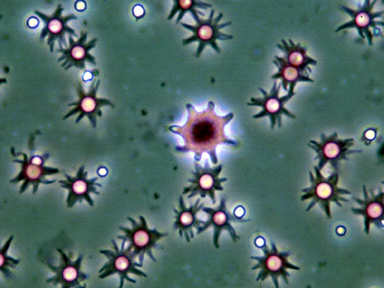 |
Figure 4: Many stellate ascospores, with an ascus in the center. Compare the size of ascospores with the ascus. |
During asexual reproduction, conidia are
produced on conidophores that terminates in a globose, vesicle on which phialide,
bearing conidia (Fig. 5) are produced. At the base of the conidiophore is a foot
cell (Fig. 6). Although the asexual stage is part of the same life cycle as the
Emericella stage discussed above, the asexual stage has a different name, Aspergillus,
which is the anamorph part of the life cycle. The genus Aspergillus, as well as
many other genera, are referable only to fungi that are known only by their asexual stage.
A special division, the Deuteromycota, was erected to accomodate these fungi, with the
understanding that should the sexual stage be discovered, the asexual name would be
dropped and only the sexual stage would be the correct name? (more will be said about the
Deuteromycota later) So, what happened? Why do we continue to maintain two
names for a single species even though both the sexual and asexual stage is known? The
main reason is a practical one. Most fungi that have an asexual and sexual stage rarely
are seen in their sexual stage and are better known by their asexual stage and are most
often referred to in the literature by their asexual stage. Thus, it was decided that both
names would be retained andd the concept of concept of telomorph and anamorph arose.
 |
Figure 5: Aspergillus variecolor, the anamorph of Emericella variecolor. The anamorph produces upright conidiophores, that swells apically into a vesicle where phialides produce conidia in chains. |
 |
Figure 6: A lower magnification of A. variecolor, showing the entire conidiophore with the characteristic foot cell at the base of the conidiophore. The foot cell and the rest of the conidiophore can readily be recognized by the thicker cell wall. |
Series: Pyrenomycetes
The series Pyrenomycetes is characterized by the formation of an ascocarp called a perithecium. This ascocarp type may be variously shaped, but is typically flasked-shaped or globose with a small ostiole through which the ascospores are released. Asci are unitunicate and are arranged, in a single fertile layer throughout the base of the perithecium or in a fascicle. Such a fertile layer is a hymenium. Sterile filaments called paraphyses may also be present among the asci. Such filaments are absent in the Plectomycetes. As the paraphyses grow into the central cavity, it becomes enlarged and provides a space where the asci and ascospores will develop. Ascospores are often forcibly ejected from the ascus and perithecium when mature. Species in this series may produce perithecia directly on their substrate or in a stroma. A stroma is a compact mass of mycelium or mycelium with host tissue, on or in which sporulating structures may be produced.
Order: Sordariales
The perithecia produced in this order ar usually dark or pallid, with asci produced in fascicles and paraphyses are absent when ascospores are mature.
Sordaria fimicola: This is an example of a
species that does not produce a stroma. In nature, this species grows on dung. Such
species are said to be coprophilous. The perithecia are small, black, flask-shaped
ascocarps with an ostiole (Fig. 7). Asci and ascospores are borne within without
paraphyses (Fig. 8).
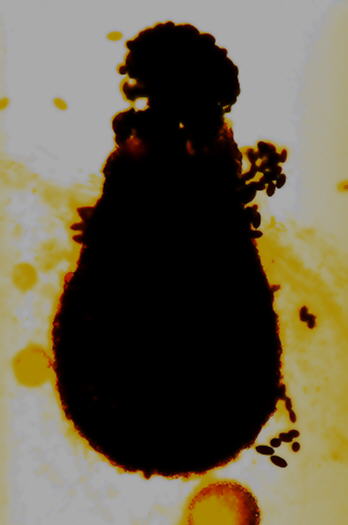 |
Figure 7: Black, flask-shaped perithecium of Sordaria fimicola. Ostiole is not visible. |
 |
Figure 8: Ascospores are dark brown, in asci on right. Asci are difficult to see, but their outlines are readily visible. |
Order Xylariales
This order includes a very large and diverse group of Pyrenomycetes that typically produce their perithecia in stromata. The shape of stroma are very variable. We will look at two examples:
Xylaria sp. and Penzigia globosum
(Figs. 9-12): These are examples of species that produce perithecia in stromata. Their
stromata are externally black, and can be seen to be mostly white in section. The
perithecia are entirely immersed in the stromata with only the ostioles opened to the
surface. The stromata of Xylaria are long and tapering (Fig. 9) while those of P.
globosum are hemisphaerical to globose that usually occur in clusters (Fig. 10). These
taxa are the most conspicuous members of the stroma producing Pyrenomycetes in Hawaii.
 |
Figure 9: Stromata of Xylaria. Stromata, on left, have white conidia covering the tips, giving it a white appearance. Stromata, on right, have swollen areas due to the perithecia pushig upward on the stroma. |
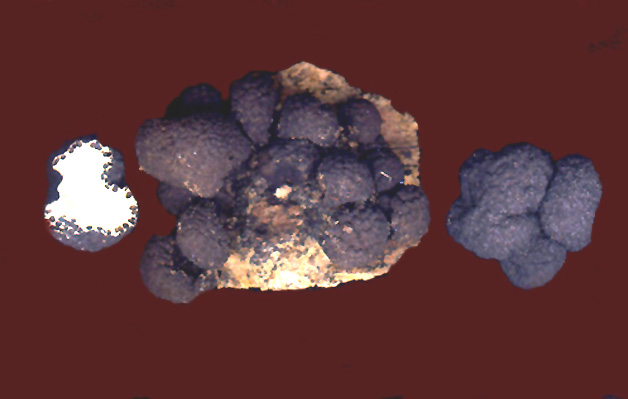 |
Figure 10: Stromata of Penzigia globosum. Sectioned stroma, on left, shows white interior and black perithecia lining periphery of stroma. |
A prepared slide of a longitudinal section through
a Xylaria stroma (Figs. 11-12) clearly shows the perithecia and ostiole breaking
through the surface of the stroma. figure is a longitudinal section through stroma
with several perithecia.
 |
Figure 11: Prepared slide of longitudinal section of Xylaria. Perithecia line the periphery of the stroma and so are able to produce ostioles on the stroma surface, through which ascospores will be dispersed. |
 |
Figure 12: Prepared slide of longitudinal section of Xylaria, at a higher magnification. |
Series: Discomycetes
The series Discomycetes is characterized by the formation of an ascocarp called an apothecium. Typically an apothecium is cup-shaped (Fig. 13) which is why Discomycetes are sometimes called "cup fung". However, the shape of the apothecium is quite variable (Figs 14-17). Whatever their shape may be, the asci form a hymenium that is usually, entirely exposed at maturity. The asci are unitunicate and forcibly eject the ascospores. Paraphyses are generally present in apothecia.
Variations in Apotheciium Configuration
From left to right: Morchella esculenta, a
species in which the apothecium has now formed depressions that are fertile with sterile
ridges in between; Leotia lubrica, a species in which the "cup" of the
apothecium is interpreted as being folded back, i.e. the hymenium is on top, giving it a
mushroom-like appearance; Gyromitra californica, a species in which the apothecium
is said to be "saddle-shaped", and the interpretation here is similar to the
previous species, but now the cup has been folded in half.
 |
Figure 13: Sarcoscypha coccinea, a typical cup-shaped apothecium. |
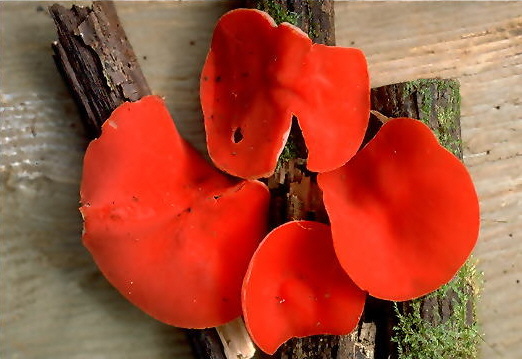 |
Figure 14: Sarcoscypha mesocyatha is more flattened and has a dish or saucer-shaped apothecium. This species was recently (1997) described as new, from Hawai‘i. |
 |
Figure 15: The morphology of Morchella esculenta, as well as other species of morels, is far different than the two examples above. The ridges that can be seen on the surface are sterile. Asci and ascospores are found only in the sunken areas of this apotheciuim. |
 |
Figure 16: The morphology of the Leotia lubrica apothecium superficially looks like a mushroom. However, the "cap" of this species is actually the apothecial surface. The apothecium is interpreted a being folden back. |
 |
Figure 17: The morphology of the Gyromitra californica is said to be saddle-shaped for obvious reason. This apothecium is interpreted as being folded back, as well, but in this species it is specifically folded back and in half. |
Series: Loculoascomycetes
The series Loculoascomycetes is characterized by producing their asci in ascostroma. An ascostroma is a locule that forms in a stroma where the asci are borne. This differs from a perithecium that is formed within a stroma in that a perithecial wall is formed by the perithecium that delimits it from the stroma. Such a wall layer is absent in the Loculoascomycetes. Asci in this series are said to be bitunicate (Fig 1). This differs from a unitunicate ascus in that the endoascus will grow through the outer layer, the exoascus, and extends beyond it through the open pore at the tip of the exoascus. This type of ascus has also been referred to as the jack-in-the-box ascus. Paraphyses may also occur in this series.
The example that we will examine in lab is the
genus Leptosphaerulina. The ascostroma in this genus is very difficult to
distinguish from perithecial species of Pyrenomycetes because it is a uniloculate
ascostroma (Fig. 18). However, if examined, microscopically, this genus can be
observed to have a bitunicate ascus, a characteristic of the Loculoascomycetes series of
Ascomycota.
 |
Figure 18: Leptosphaerulina sp.: An example of a uniloculate ascostroma. In this type of stroma it would be very difficult to distinguish if it is a perithecium rather than an ascostroma. However, the characteristic of the bitunicate ascus is a reliable feature in determining that this fungus is a Loculoascomycetes. |