WB01343_.gif (599 bytes) Hepatophyta - Marchantiales - 2 WB01339_.gif (896 bytes)

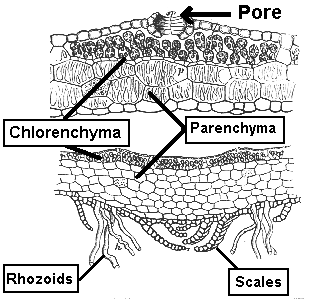
Their Growth Form is said to be Thallose.This means Flat without leaves, stems or roots. They are Ribbon-Like in appearance. Note the various Tissues present in the adjacent cross-sections. The upper section is through the Margin of the Thallus. The lower one is through the "Midrib".The thallus is Dorsiventral as  there are distinct upper (dorsal) and lower (ventral) surfaces.

These plants appear to be simple but they show a considerable amount of Tissue Differentiation
& Functional Differentiation. Note the Comparmentation of the Thallus.
Does this have functional significance? Think about the Titanic!
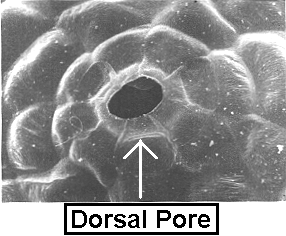
External Traits include a well developed, waxy Cuticle on the Dorsal surface. This is produced by the Epidermis. The Epidermis represents a "killer adaptation" that is present in virtually all terrestrial plants. By "killer" I mean one that is of overwhelming importance. We will see many epidermal adaptations which have tremendous adaptive significance! The Cuticle is also impervious to CO2 and O2. This presents a distinct problem for autotrophs. They produce O2 but they need CO2 for Photosynthesis & CO2 is in short supply in the atmosphere. Multicellular Epidermal Pores provide an avenue for gas exchange between the thallus and the air. These have Several Tiers of Cells & the Lower Cells Open <&> Close in response to H2O levels.These are Analogous to Stomata but NOT Homologous.They are only seen on the Dorsal Surface. Is this a coincidence or might there be functional (adaptation) significance to their location?The Ventral Epidermis also has some significant adaptations.  It produces Scales which hold water via Capillary Action and help to anchor the plant. Capillary Action can be seen by placing the edge of a tissue on a drop of H2O. The water is attracted to the small, charged spaces that exist between the cellulose fibrils. Consequently the water moves into the tissue. There are strong forces called matrix potential which hold water molecules close to charged surfaces. It is thus difficult for water to evaporate from such spaces once it is absorbed. If you were a Marchantia you would love to have nice Ventral Scales!


Note the Rhizoids and Scales on the Ventral surface. What might they do?

Pores240Lab.jpg (58227 bytes)
Note the Pores!
Also note the honeycomb-like segmentation of the thallus. If one compartment is destroyed, are adjacent ones more or less likely to die than if only one compartment existed?
The reflective nature of the surface is due to the presence of Cutin which is the major component of the Cuticle. The Cuticle is impervious to air and water. It prevents excessive water loss to the atmosphere.  It also keeps pathogens out!

PoreHZ.jpg (66712 bytes)
Dorsal Surface with Shiny Cuticle & Pores
SEM Photo of a Marchantia Pore

MarcundrLab.jpg (80280 bytes)


Multicellular Rhizoids are also present. These help to anchor the thallus and probably assist in water acquisition.

WB01342_1.gif (412 bytes)

Lecture Topics