Pterophyta Filicales |
|
|
|
This is a large and familiar taxon. We are only studying the Filicales. However, there are several other classes that we are not considering.
The Filicales is the largest and most wide-spread taxon of ferns, and thus the best representatives this Division. They occupy a wide range of habitats. They are commonly terrestrial or epiphytic in the Tropics. Terrestrial forms predominate in the Temperate zone.
 |
|
 |
| Ferns covering a rock at the Pali Overlook (Oahu) | Staghorn Fern A Most Famous Epiphyte | Filmy Fern Manoa Cliffs Trail (Oahu) |
The Filicales
contains many large families including the Polypodiaceae,  Osmundaceae,
& Cyatheaceae plus several others. There are approximately 300 genera & 9,000
species. These are most
abundant in the humid tropics but they are also plentiful
in temperate regions, including temperate rainforests like those found on
the Olympic peninsula (Washington) and New Zealand. A few species are aquatic or
semi-aquatic while a few species can survive in arduous environments.
Osmundaceae,
& Cyatheaceae plus several others. There are approximately 300 genera & 9,000
species. These are most
abundant in the humid tropics but they are also plentiful
in temperate regions, including temperate rainforests like those found on
the Olympic peninsula (Washington) and New Zealand. A few species are aquatic or
semi-aquatic while a few species can survive in arduous environments.
Ferns are relatively
small plants and they do not generally dominate ecosystems, However, they can be very important in certain
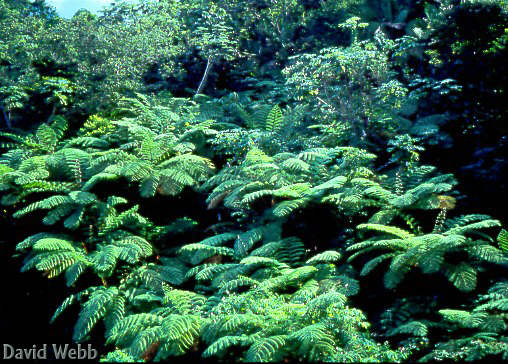
environments. Tree ferns may be
among the dominant species is certain habitats. This is true for the Hawaiian
Islands. Ferns have greater ecological significance in Hawaii than
elsewhere due to the absence of competitors which would normally displace
them as sites mature. In some cases ferns are the only significant ground
cover in Hawaiian forests and open slopes. They are consequently important
for soil stabilization and erosion control. They should be considered for the initial
revegetation of disturbed sites.
ecosystems, However, they can be very important in certain
environments. Tree ferns may be
among the dominant species is certain habitats. This is true for the Hawaiian
Islands. Ferns have greater ecological significance in Hawaii than
elsewhere due to the absence of competitors which would normally displace
them as sites mature. In some cases ferns are the only significant ground
cover in Hawaiian forests and open slopes. They are consequently important
for soil stabilization and erosion control. They should be considered for the initial
revegetation of disturbed sites.
The
class that we are studying is characterized by pinnate leaf organization.
This is evident in their venation (vein
pattern) and the overall appearance of their lamina
(blade). However, there are ferns
which have entire, lanceolate leaves. Some have Palmate organization.
organization.
This is evident in their venation (vein
pattern) and the overall appearance of their lamina
(blade). However, there are ferns
which have entire, lanceolate leaves. Some have Palmate organization.
Another
diagnostic leaf characteristic is Circinate
Vernation. Immature leaves are tightly coiled and
tightly packed at the shoot apex. The leaves begin to uncoil when favorable
conditions occur. They resemble the tops of violins and have been called "fiddle
heads". They also resemble the shepherd's crook and have been so named. The fiddle
heads mature from the base towards the tip (acropetal
maturation). Consequently, the lower sections of the petiole and blade mature first. The leaflets of compound leaves also display
circinate vernation.
and have been called "fiddle
heads". They also resemble the shepherd's crook and have been so named. The fiddle
heads mature from the base towards the tip (acropetal
maturation). Consequently, the lower sections of the petiole and blade mature first. The leaflets of compound leaves also display
circinate vernation. 
Ferns have Megaphylls (large
leaves). However, size is not the chief characteristic of
megaphylls. A Megaphyll is a
leaf which contains more than one vein and its leaf
trace is associated with a leaf gap
in the stele. A leaf gap occurs when the departure of a leaf trace from the stele results
in the development of parenchyma rather than vascular tissues in the stele, just above the
leaf trace. This gives the stele a dissected appearance like the dictyostele.

Some ferns have very simple leaf organization with little mesophyll differentiation. Others have a complex anatomy which rivals the structural specialization of angiosperm leaves.