 From Cell to Organ-1

The
Invasion of the Land is really the
Invasion of the Atmosphere!!!
The Protoplasm of
Individual Plant Cells is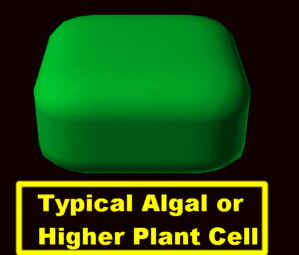 surrounded by a Cellulose Wall. While Cellulose is strong
and prevents mechanical damage to the cell contents, it is extremely hydrophilic and
readily absorbs water.However, Cellulose easily loses water via evaporation. Cellulose is
like a sponge. If you drop a sponge in water, it saturates instantaneously. A wet sponge
readily loses water when it is placed on a dry substrate. In
surrounded by a Cellulose Wall. While Cellulose is strong
and prevents mechanical damage to the cell contents, it is extremely hydrophilic and
readily absorbs water.However, Cellulose easily loses water via evaporation. Cellulose is
like a sponge. If you drop a sponge in water, it saturates instantaneously. A wet sponge
readily loses water when it is placed on a dry substrate. In 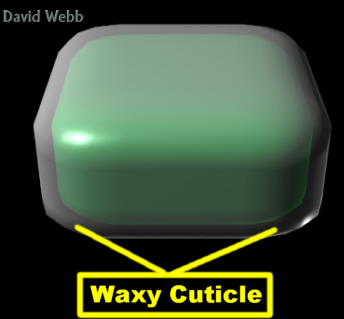 order
for an isolated plant cell, like a unicellular alga, to survive, it must be in constant
contact with water.
order
for an isolated plant cell, like a unicellular alga, to survive, it must be in constant
contact with water.
In order to withstand periodic dry spells, plant cells needed a water protective coating. One of the most important plant adaptations is the Cuticle. It is a waxy material that is secreted to the outside of the plasma membrane. It fills in the spaces between cellulose fibrils and forms a continuous external waxy layer to the outside of the cell wall. This makes the cell watertight!
This cell can be
called an "all purpose" cell because it
regulates its water balance and
performs photosynthesis.
The Cuticle keeps
water inside but it 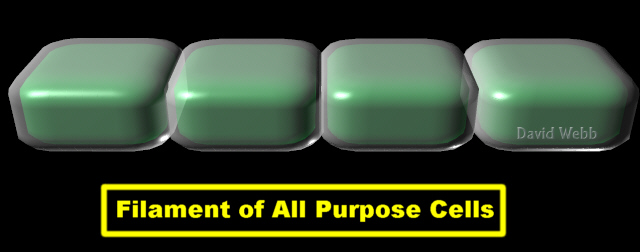 also prevents water uptake. The
Cuticle is usually thicker on the side of the cell facing the light. Consequently, water
could enter the bottom of the cell where the cuticle is
also prevents water uptake. The
Cuticle is usually thicker on the side of the cell facing the light. Consequently, water
could enter the bottom of the cell where the cuticle is thin and where water is more abundant, and be retained within the cell by the thick
cuticle on its upper side. This could lead to the formation of colonies. The first
multicellular forms could be filaments. These might be followed by flat sheets.
thin and where water is more abundant, and be retained within the cell by the thick
cuticle on its upper side. This could lead to the formation of colonies. The first
multicellular forms could be filaments. These might be followed by flat sheets.
