I. Diagnostic Characters of the Red Algae.
 |
How many are there? about 600 genera with 5500 morphological species. | ||||||||
|
How old are they? 590 million years old for those with calcification. | ||||||||
|
Where are red algae found?
|
||||||||
|
How are their cells organized? One to multinucleate organization. | ||||||||
|
What pigments do they possess?
|
||||||||
|
How is the chloroplast constructed?
|
||||||||
|
What storage product is made?
|
||||||||
|
Cell wall features?
|
||||||||
|
Cell and thallus complexity?
|
II. Simplest cell construction.
There is no sexual reproduction cycle know for this alga.
III. Developmental lineages and a single life history strategy.
Simple to increasingly complex (Orders Bangiales and Nemaliales) with the intermediate life history strategies, the Sporic Meiosis pattern
|
Porphyra w/ a heteromorphic alternation of generations via the conchocelis phase. |
|
Liagora typically with a heteromorphic alternation of generations via a microscopic phase. |
These genera typically reproduce via the Sporic Meiosis Life History
Increasingly complex adult morphologies (Order Gigartinales) and intermediate life history
|
Gracilaria |
|
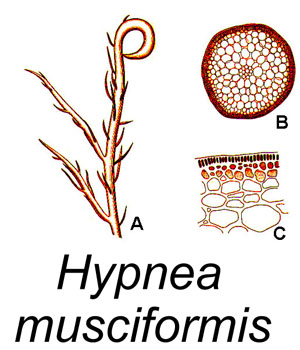
Hypnea |
All of these genera reproduce via the Sporic Meiosis Life History
Most complex adult morphology (Order Ceramiales) and intermediate life history
|
Polysiphonia |
|
Laurencia |
All of these genera reproduce via the Sporic Meiosis Life History
IV. Recap major themes.
Increasing complexity shown in changes in adult morphologie. Life history strategies have subtle distinctions among orders.
Gamete type is extremely conservative character with all sexually reproducing species having oogamy - a nonmotile "egg" and spherical (non-motile) males.
Is there any significance to the males being colorless?
V. 
Overview of Red Algae from UC Berkeley
Overview of California red algae @ Sonoma State Univ
Porphyra culture
This page is maintained by Celia Smith and intended for use by undergraduates and graduates, Botany Dept, Univ Hawai'i at Manoa.