|
|
The Leaves of the Magnoliophyta are Megaphylls! They range from the simple & minute Duckweed (Lemna) to the large and complex (Palms).
|
|
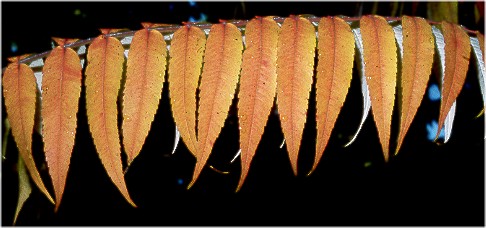 A Compound Leaf of Sumac (Dicot) |
 Taro (Monocot) |
In most cases the Mesophyll is Complex & specialized for maximal photosynthetic efficiency. It is common to find Palisade & Spongy layers. Some plants have a distinctive arrangement of Photosynthetic cells and Vascular Bundles called Kranz (Wreath) Anatomy. This is associated with C4 Photosynthesis.
|
|
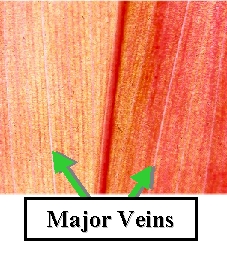
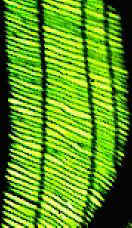
Leaf Venation is generally intricate and net-like (Reticulate). Both Dicots and most Monocots have reticulate Venation. A careful inspection of plants with "parallel venation" reveals the fact that their long, parallel veins are interconnected by lateral veins.
 Reticulate in Ohi'a Lehua after the removal of its Trichomes |
|
|
|
Temperate and subartic species produce hardy buds which are similar to those we saw for the Coniferophyta. They are composed of tiny modified leaves called bud scales!
|
|
 Ohi'a Lehua Leaf Section showing dense layer of Trichomes (T) on the lower surface and a Thick Cuticle (C) on the upper surface. |
Vegetative Leaves & Stems produce many different types of Epidermal hairs or Trichomes. These serve many functions which include the reflection of light, protection from excess evapotranspiration, protection from herbivores, attraction of pollinators and the capture of prey. No other group of plants comes close to the Anthophyta when it comes to the production of Epidermal hairs. Their adaptive significance is tremendous!