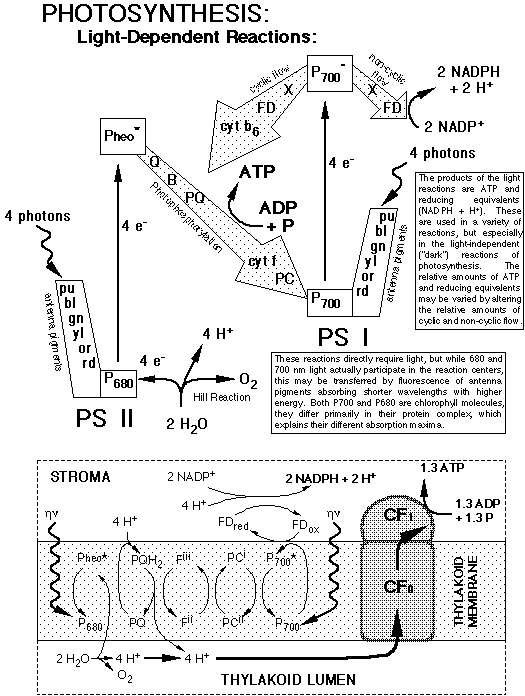
Your book is really quite good in this half of photosynthesis. It covers the history of discovery and the photo-electronic-chemi-osmotic processes involved in the so-called "light reactions." You should read it closely.
I think the parallelisms between respiration and photosynthesis were worthy of emphasis, so here is an over-simplified diagram... (you might have to widen your Netscape window to see this correctly).
RESPIRATION:
        ____________                _____________            _______________
       | glycolysis |              | Krebs cycle |--> CO2   | ETS & Ox Phos |
sugar -|------------|--> pyruvate -|-------------|--> NADH -|---------------|--> H2O
       |  cytosol   |              | mito matrix |          | mito inner mem|<-- O2
       |____________|              |_____________|          |_______________|==> ATP!!                                                 \-->ATP

PHOTOSYNTHESIS:
          _____________              ______________             __________________
         | sucrose syn |            | Calvin cycle |           | Light React & PP |<=== LIGHT!!
sugar <--|-------------|- triose <--|--------------|- NADPH <--|------------------|<--H2O
         |  cytosol    |            |chloro stroma |<-- ATP <--| chloro inner mem |\-->O2
         |_____________|            |______________|<-- CO2    |__________________|
You should be able to reproduce those basic relationships between these two processes. You should be aware of the fundamental arrow-direction differences, and the three distinct phases shared by the two reaction pathways.
Respiration:
CH2O + O2 --> CO2 + H2O + ATP
Photosynthesis:
CO2 + H2O + light --> CH2O + O2
The two reaction systems are basically the reverse of each other. One undoes the other in plants. Since plants do not eat to supply their energy needs, the plant must do enough photosynthesis to meet its needs for maintenance, growth, and reproduction while compensating for losses due to respiration both night and day.
Go back to the Course Schedule.