Polymers and
Plastics
Table1
Links in the
Chain
|
Monomer
|
Common Name
|
Polymer
|
Abbreviations
|
Comments
|
Production*, lbs x
10-9
|

|
ethylene
|
polyethylene
|
PE, LDPE, LLDPE, HDPE
|
Used in plastic bags, milk jugs
|
27.136
|

|
propylene
|
polypropylene
|
PP, HDPP
|
Used in indoor-outdoor carpet, clothing
|
13.320
|

|
styrene
|
polystyrene
|
PS
|
Used in food industry as packaging material.
|
6.380
|

|
vinyl chloride
|
poly(vinyl chloride)
|
PVC
|
Used in plumbing and vinyl siding, Tygon™
tubing.
|
14.084
|

|
vinyl acetate
|
poly(vinyl acetate)
|
PVA (polyvinyl alcohol)
|
PVA, which is made from poly(vinyl acetate) is used as a
water-soluble adhesive. It is also used in hair sprays.
|
......
|

|
methyl methacrylate
|
poly(methyl methacrylate)
|
PMM
|
Commercially known as Plexiglass.
|
......
|

|
acrylonitrile
|
polyacrylonitrile
|
PAN
|
Commercially known as Orlon.
|
......
|

|
tetrafluoroethylene (perfluoroethylene)
|
poly(tetrafluoroethylene)
|
PFE
|
Commercially known as Teflon.
|
......
|
* Source = Society of the Plastics Industry
The data in the last column represents the
total US production and sales of polyethylene, polypropylene,
poly(vinyl chloride), and polystyrene in billions of pounds for
1997.
PE = polyethylene; typical densities average
0.906 g/mL
HDPE = high density polyethylene; typical
densities average 0.946 g/mL
LDPE = low density polyethylene; typical
densities average 0.922 g/mL
LLDPE = linear low density polyethylene;
typical densities average 0.918 g/mL
PP = polypropylene; typical densities average
0.902 g/mL for isotactic material, 0.900 g/mL for
syndiotactic.
PVC - poly(vinyl chloride); typical densities
average 1.400 g/mL
Additives and
Plasticizers
If you look at Table 1, you will notice that
poly(vinyl chloride) is used to make both rigid PVC pipe and flexible
Tygon™ tubing. Similarly, the polystyrene in food packaging
materials is clear and brittle, while polystyrene "peanuts" are soft
and multi-colored. How can the same material have such different
properties? In the case of PVC the difference between rigid pipe and
flexible tubing stems from the addition of plasticizers. These
materials, which are added to the polymer after it has been prepared,
are not chemically bonded to the polymer, but rather form a physical
mixture with it. One of the most commonly used plasticizers is
di-(2-ethylhexyl phthalate):
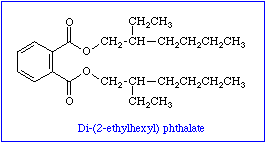
Exercise
1 What structural feature of
di-(2-ethylhexyl) phthalate that confers flexibility on PVC?
This compound is also used in food packaging materials such as Saran
Wrap™. Public safety advocates have recently raised concerns
about its use as a packaging material, especially for meats, because
it has been shown to be carcinogenic when administered to laboratory
animals in very large dosages. It is also suspected to disrupt
hormone function in
both men and women.
Exercise
2 The argument against using plastic
wrap that contains di-(2-ethylhexyl) phthalate to package meat
products contends that the fat in the meat leaches the plasticizer
from the wrapping material, thereby contaminating the meat. Is this
reasonable? Can you think of an adage that suggests the
possibility?
In addition to plasticizers, many commercial polymers contain other
additives, especially colorants. Two of the most common colorants are
charcoal, for black plastics, and titanium dioxide, for white
products. Gases are also used as additives. For example, mixing air
into polystyrene leads to the formation of the "peanuts" used as
packaging material. Air is also used in the manufacture of neoprene
wetsuits. In both of these applications gas bubbles become entrapped
in the polymer as its viscosity increases during the polymerization
process.
Topics