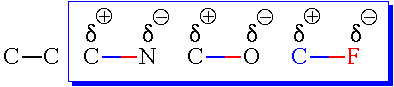
In most stable organic compounds bonds to carbon are either non-polar (C-C) or they have a bond dipole in which the carbon atom is positive (C-X). Figure 1 summarizes the normal state of affairs.
The basic idea behind synthetic organic chemistry is simple: mix a compound which contains an electron rich carbon with one that contains an electron deficient carbon and Coulomb's Law will do the rest. The problem lies in making compounds that contain a negatively charged carbon atom. One of the most common ways to do so is to convert an alkyl halide into an organometallic compound. The Wittig reaction offers another approach.
The Wittig reaction is a one-pot, three-step sequence that converts aldhydes and ketones into alkenes. The three steps are:
Figure 2 illustrates each of these steps.
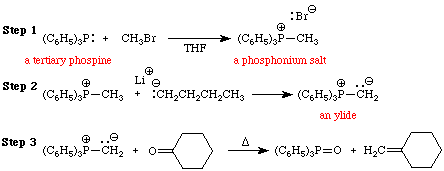
The first step of the sequence involves an Sn2 reaction in which the phosphorous displaces the bromine from the methyl bromide. (As such, it is subject to all the usual limitations of the Sn2 mechanism.) The resulting phosphonium salt generally precipitates from the reaction mixture as a white solid. The positive charge on the phosphorous atom of this salt pulls electron density away from the C-H bonds of the methyl group, making those hydrogens more acidic. Addition of a strong base, in this case n-butyl lithium, deprotonates the methyl group. The carbanion that is produced is called an ylid. The negatively charged carbon gains stabilization by donating electron density into a vacant d orbital on the phosphorous atom:

As the phosphonium salt reacts with the butyl lithium, it disappears and an orange solution is formed. Addition of the ketone to this solution, followed by a brief period of reflux, produces the alkene along with a white precipitate of triphenylphosphine oxide.
The value of the Wittig reaction lies in its generality. It works well with aliphatic and aromatic aldehydes and ketones. Furthermore, these compounds may contain other functional groups such as alcohols and esters which are not compatible with Grignard reagents.
Is it possible to accomplish the synthesis outlined in Figure 2 using Grignard chemistry? Reaction of cyclohexanone with methyl magnesium bromide would produce 1-methylcyclohexanol. But dehydration of this alcohol using concentrated sulfuric or phosphoric acid may produce 1-methylcyclohexene and/or methylenecyclohexane. Being a trisubstituted alkene, 1-methylcyclohexene is more stable than methylenecyclohexane, and it is the preferred product. Figure 3 summarizes this alternative.

The Wittig reaction converts aldehydes and ketones into alkenes.

Scheme 1 describes two steps in the total synthesis of monensin.
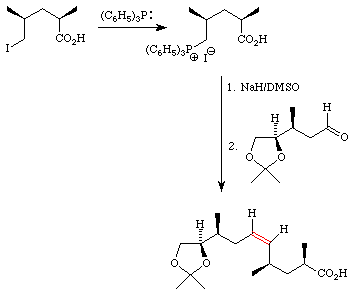
The desired cis alkene was formed in approximately 70% yield along with about 20% of the undesired trans isomer. Note the use of the cyclic ketal as a protecting group during the last step of the sequence.
A similar strategy was utilized during the total synthesis of racemic progesterone as outlined in Scheme 2.

The Wittig reaction generally gives a mixture of cis and trans isomers. In this instance, the cis/trans mixture was treated with additional phenyl lithium to isomerize the cis alkene to the more stable trans configuration. (The methanol is merely a source of protons.)
An interesting example of the Wittig reaction comes from a synthesis of leukotriene A4 as shown in Equation 1.
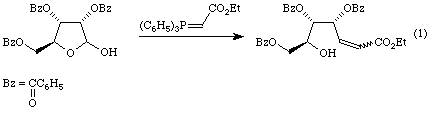
The starting material in this reaction is a cyclic hemiacetal. Under the reaction conditions it exists in equilibrium with a small amount of the corresponding hydroxy aldehyde. The squiggly line between the carboethoxy group and the double bond indicates that the product is a mixture of the cis and trans isomers.