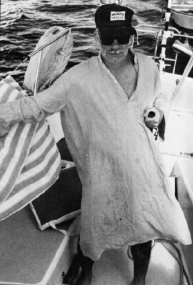
Daniel Kohl tills more than the soil for his soybeans: shown here at his tiller in the Caribbean
The N2 fixing machinery resides in microsymbionts, called bacteriods. Energy dervied from leaf photosynthesis provides the energy for the massively energy intensive reduction of N2 to ammonia and for all other bacteroid functions. Paradoxically, the hig h demand for ATP must be meet in an environment which is very low in free, dissolved O2 since nitrogenase is irreversibly poisoned by very low [O2]. Some of the energy in C-C bonds is conserved as ATP. The rest is released as heat. Since it is possible to measure directly heat release during metabolism, we are trying to determine whether some reduced carbon substrates are more closely linked to ATP production than are other substrates. In the latter case, uncoupled electron transport might serve to co nsume O2 at a rate sufficient to provide the required environment for the functioning of the N2 fixing system.